
PSYONIC Announces Partnership with ABB Robotics & NVIDIA Robotics
PSYONIC, NVIDIA, ABB Robotics PRESS RELEASE - June 22, 2026
At Automate 2026, PSYONIC showcases how human-generated manipulation data captured through the Ability Hand could help accelerate robotic dexterity across simulation and real-world industrial applications.
CHICAGO, IL – June 22, 2026 – PSYONIC, a leader in dexterous manipulation technology, announced new milestones in its mission to bridge human capability and robotic intelligence through collaborations with ABB Robotics and NVIDIA. Building on the company's recent integration of the Ability Hand into NVIDIA Isaac Lab, PSYONIC is now demonstrating how human-derived dexterity data may help advance robotic manipulation and support the development of next-generation physical AI systems.
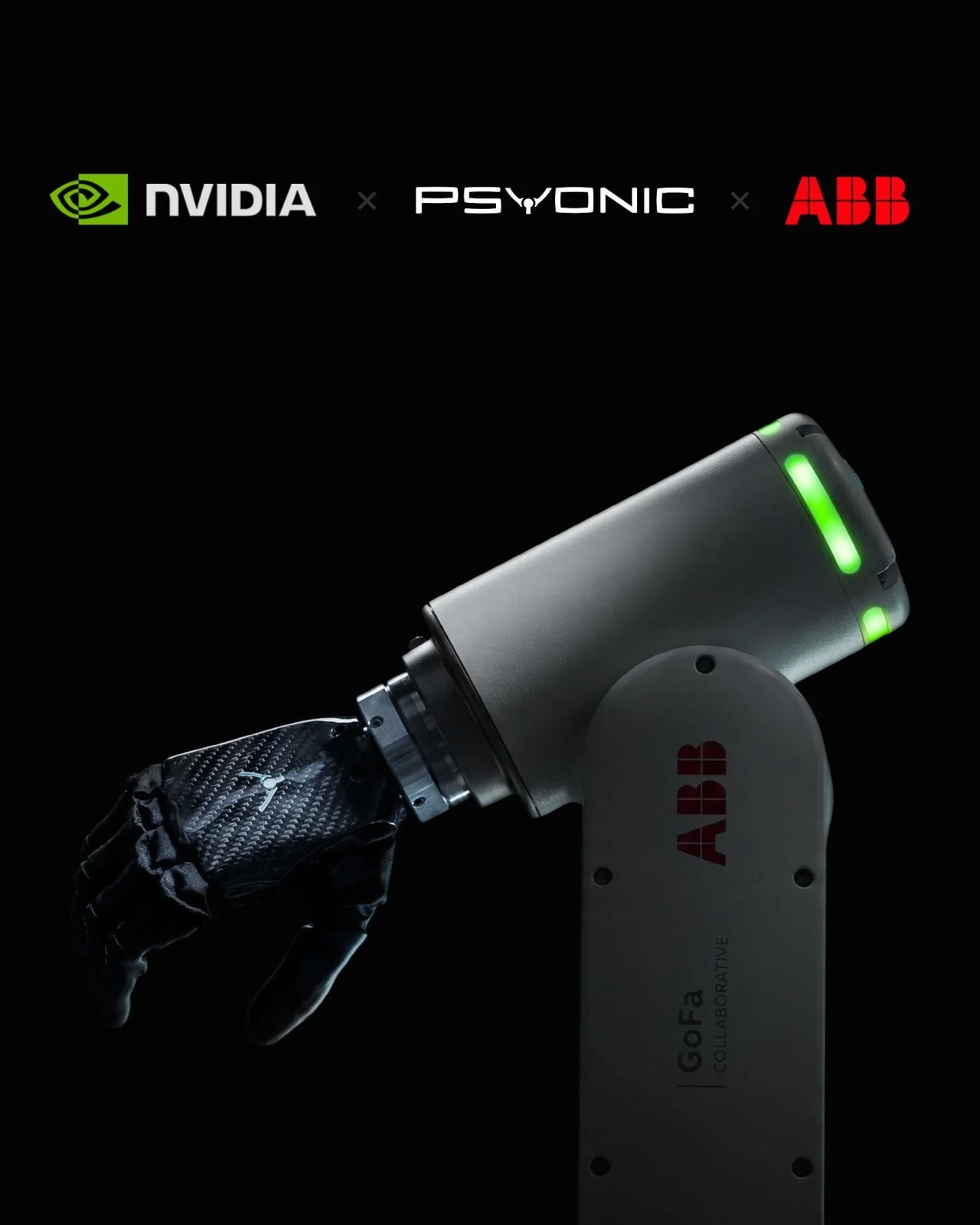
At Automate 2026, PSYONIC is highlighting its collaboration with ABB Robotics, which integrates the PSYONIC Ability Hand with ABB's GoFaTM collaborative robot. Together, the companies are exploring how touch sensing, compliant mechanics, and human-derived manipulation data can improve robotic handling of delicate, irregular, and variable objects in industrial environments.
The collaboration builds upon PSYONIC's broader work with NVIDIA to explore how human-generated manipulation data could help improve robotic learning workflows. By combining the NVIDIA Isaac Lab open robot learning framework, ABB Robotics' industrial automation platform, and PSYONIC's touch-enabled Ability Hand, the companies are helping establish a framework for evaluating how human dexterity data can inform robotic manipulation.
"Dexterous manipulation remains one of the biggest challenges in robotics," said Dr. Aadeel Akhtar, Founder and CEO of PSYONIC. "The same Ability Hand that helps amputees interact with the world can also provide a unique opportunity to capture high-fidelity data on movement, contact, and grip force. Through our collaborations with ABB and NVIDIA, we're exploring how that data can help advance robotic manipulation and contribute to the future of physical AI."
Earlier this year, PSYONIC announced that the Ability Hand became one of the first commercially deployed dexterous hands integrated directly into NVIDIA Isaac Lab, an open-source framework for robot learning. The integration enables researchers and developers to simulate, train, validate, and deploy manipulation policies using a sensorized bionic hand already operating in real-world environments.
Through this work, PSYONIC introduced a novel "real-to-real" transfer approach designed to capture authentic human manipulation behavior and evaluate how that data can improve robotic learning. Unlike approaches that rely primarily on synthetic simulation data, real-to-real transfer leverages physical interaction data collected from the same hand used by both humans and robots, creating a unique opportunity to bridge human dexterity and robotic performance.
Originally developed for prosthetic users, the Ability Hand combines touch sensing, vibration feedback, compliant mechanics, and multi-articulating dexterity in a lightweight design. The hand's integrated sensing architecture allows users to detect contact and grip force while generating rich datasets that may help researchers and developers better understand dexterous manipulation.
"Physical AI requires more than powerful models. It requires meaningful interaction with the physical world," said Akhtar. "We believe human-generated manipulation data represents an important and largely untapped resource for robotics. Our goal is to explore how that data can contribute to more capable and adaptable robotic systems across manufacturing, logistics, healthcare, and beyond."
As autonomous systems increasingly move into unstructured environments, access to physically grounded manipulation data is becoming increasingly important. PSYONIC's work seeks to create a closed-loop workflow in which human interaction data can be captured, analyzed, and evaluated as a resource for improving robotic learning and dexterous manipulation.
Visitors to Automate 2026 can learn more about how PSYONIC, ABB Robotics, and NVIDIA are exploring new approaches to robotic dexterity and physical AI through real-world human data and next-generation robotic learning platforms.
About PSYONIC
Founded in 2015 and based in San Diego, PSYONIC is a leader in dexterous manipulation technology. The company develops advanced bionic systems designed to supercharge both humans and robots. By combining speed, strength, durability, and sensory feedback, PSYONIC advances technology at the intersection of robotics, brain-computer interfaces, and AI. The PSYONIC Ability Hand is the fastest dexterous hand on the market and the first to deliver touch feedback, enabling intuitive physical interaction for human users while generating rich datasets that may help advance robotic dexterity.
Contact:
PSYONIC, Inc.